
Columbia Earlier Resident Sources
Build an address history in layers. The Richland County property record supplies the current parcel anchor, and the Register of Deeds, or ROD, supplies recorded transfer leads. Historical directories and telephone books can put a named household or subscriber at an address in a dated issue. Census records and obituaries add household and life-event context. None of those sources alone proves every person who lived there. A deed party may be an owner who did not occupy the property, while a directory is a listing for its particular edition.
| Source | Years It Covers | Where Held | What It Shows |
|---|---|---|---|
| ROD searchable index | Jan. 10, 1984-present | Richland SMS or ROD counter | Parties and instrument leads, with address and tax-map gaps possible |
| ROD online images | Feb. 19, 1998-present | Richland SMS subscription | Viewable recorded instruments |
| Columbia city directories | 1859-1927, with gaps | USC collection and local history sources | Dated name, address, and business or household leads |
| Telephone directories | 1931-1951 reference holdings; digital examples through 1954 | Walker Local and Family History Center | Subscriber and local-context clues |
| Federal census and Sanborn | Latest public census: 1950; 1919 Sanborn has 77 sheets | National Archives, library sources, Library of Congress | Household snapshot or building and street setting |
Use the current parcel and recorded deed first when the question begins with a modern address. For an older era, start with the nearest available directory issue, then test the address against a parcel description, map, and later transfer record. The ROD counter and copy route remain part of the process when an online result does not carry the needed image.
Columbia Previous Residents: Address Identity
Before following any family name, record the property card's situs address, tax-map number, and legal description. The situs is the physical street location. A legal description identifies the land through a lot, subdivision, plat, or metes-and-bounds description and usually survives a changed street label better than a typed address. Richland County recommends a tax-map search at the ROD, but the County also warns that an address or tax-map number is not required on every recorded document.
That warning matters when searching previous residents. A blank street-address result is not proof that the deed trail ended. Compare the current acquisition instrument with its derivation clause, plat reference, and legal description before treating a similar number as the same Columbia parcel. A mailing address on a tax card is correspondence data, not a statement that the named owner lived at the situs.
Note: Columbia addresses can fall in Richland or Lexington County, so establish the parcel's county before choosing a recorder or probate office.
Columbia Past Resident ROD Cutoffs
The Richland County Subscription Data Services system has a paid online index from January 10, 1984 forward. Its stated online image range begins February 19, 1998. Those dates are different on purpose. An index hit between the two can identify an instrument even when its image still needs to come from the ROD counter, microfilm, or a copy request. The counter is also the fallback for earlier records.
The Richland County Register of Deeds is at 1701 Main Street, Room 101. Staff cannot conduct a search for a requester, so bring a known party, book and page, instrument number, tax-map number, address, or legal description. A mailed copy request works best when it identifies the known instrument rather than asking the office to reconstruct a household history.
The ROD's stated channels matter when an older link is needed. Office printouts are listed at 25 cents per page, instrument or microfilm copies at 51 cents per page, and plats at 78 cents per page. The County lists a mailed copy request at $15, including certification and a self-addressed stamped envelope, while certification of a true copy is $10. Ask for the applicable copy cost before mailing payment, and identify the instrument by book and page or another known reference.
Note: An online image gap is an access issue, not evidence that a recorded transfer is missing from the Columbia history.
Trace Columbia's Prior Resident Deed Chain
A chain of title is a sequence of recorded transfers for the same land. It tracks land interests, not an automatic list of past residents. Start with the current owner's acquisition deed, then use the seller's earlier purchase to step back one transaction at a time. The legal description is the continuity test at each step.
- Search the Richland property record by address, owner, or tax-map number and copy the exact situs, tax map, and legal description.
- Use the ROD's tax-map, legal-description, party, address, or book-and-page search to find the current acquisition instrument.
- Capture the grantor, grantee, recording date, instrument or book and page, and the derivation clause if shown.
- Search the seller as a grantee to locate that seller's earlier acquisition, then compare the legal description and plat reference.
- Repeat backward. For pre-1984 index work or pre-1998 images, request the record at the counter or through the copy process.
- Grantor
- The party transferring an interest in the recorded instrument.
- Grantee
- The party receiving that interest. Searching a seller as grantee can reveal the earlier acquisition.
- Chain of title
- The tested sequence of transfers for one parcel, linked by descriptions and recorded references.
- Legal description
- The parcel description in a recorded instrument. It is stronger continuity evidence than a street number alone.
Columbia's 1865 Records Break
Columbia's early trail has a real historical break. Federal occupation and a February 1865 fire destroyed the courthouse and most county records, according to the South Carolina Department of Archives and History. Equity and probate records had been removed to safety, but an early deed or court trail can still stop even when the modern ROD search works perfectly. That is a records-history fact, not proof that a household was absent.
Post-fire and reconstructed material can still help. The archives guide identifies conveyance books from 1865-1951, general conveyance indexes from 1872-1908, tax duplicates from 1876-1960, and selected probate series. Date each source and allow the gap to remain visible rather than filling it with an unsupported conclusion about an earlier household.
Columbia Previous Residents in Directories
Deeds explain ownership changes. Directories and census schedules test the household layer. USC's documented Columbia city-directory run begins in 1859 and continues through 1927 with gaps. Richland Library holds later telephone directories, including reference years from 1931 through 1951 and digitized examples from 1935, 1942, and 1954. A telephone directory lists subscribers, so a missing name does not settle occupancy. The historical volumes themselves are described in more detail on the Columbia city directory page.
A 1905 Columbia Street Department view shows the kind of historical street surface that can connect an address to a dated listing.
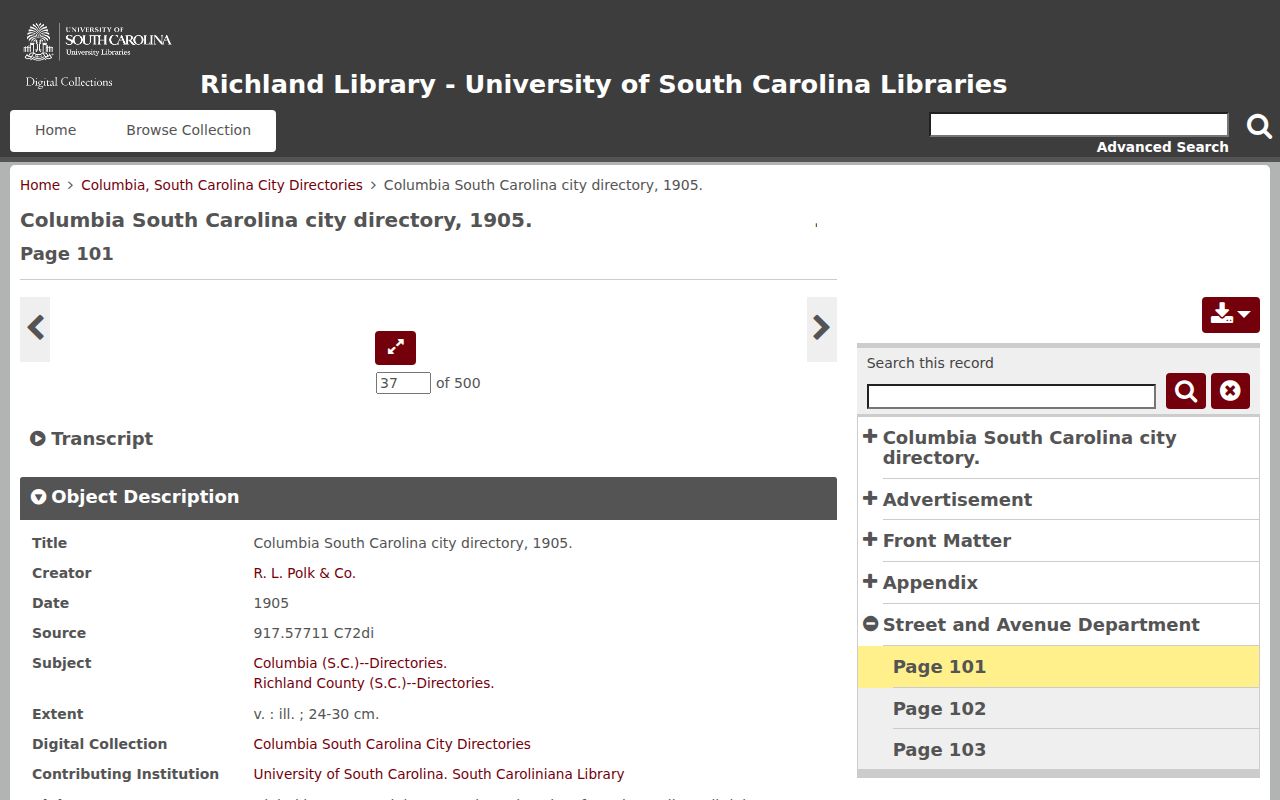
Copy a street spelling, number, initials, and nearby cross streets exactly, then compare the preceding and following available issues. Use the nearest publicly released federal census, currently 1950, as a separate household snapshot. A changed number, spelling, or missing listing is a fact to test against the parcel trail, not a ready-made move date.
Directory and census flow: dated address or surname → closest directory or telephone issue → earlier and later available issues → 1950 or an earlier released census → ROD and property record for land continuity → obituary or probate check for a final transition.
The 1905 Street and Avenue Department is a dated aid, not a rule for all Columbia addresses today. It described alphabetical street listings, 100 numbers per block, and an even and odd side convention. Test an uncertain old number against the listed cross streets, ward or neighborhood wording, plat, and map sheet. Research did not verify a citywide renumbering date, so it is better to describe an address mismatch than to invent a conversion.
Columbia Previous Residents in Map Context
The 1919 Columbia Sanborn volume has 77 sheets. It can show building footprint, use, street arrangement, and block context at that time, but it does not identify the people who occupied a building. Use it after the deed, tax-map, or dated directory evidence has located the parcel. Historic street references can also require name variants, such as Walnut for Blanding, Lumber for Calhoun, Upper for Elmwood, Medium for College, or Green for Greene.
Historic Columbia's property-research consultation is a local research-assistance route for origins, ownership, maps, photographs, and public-record leads.
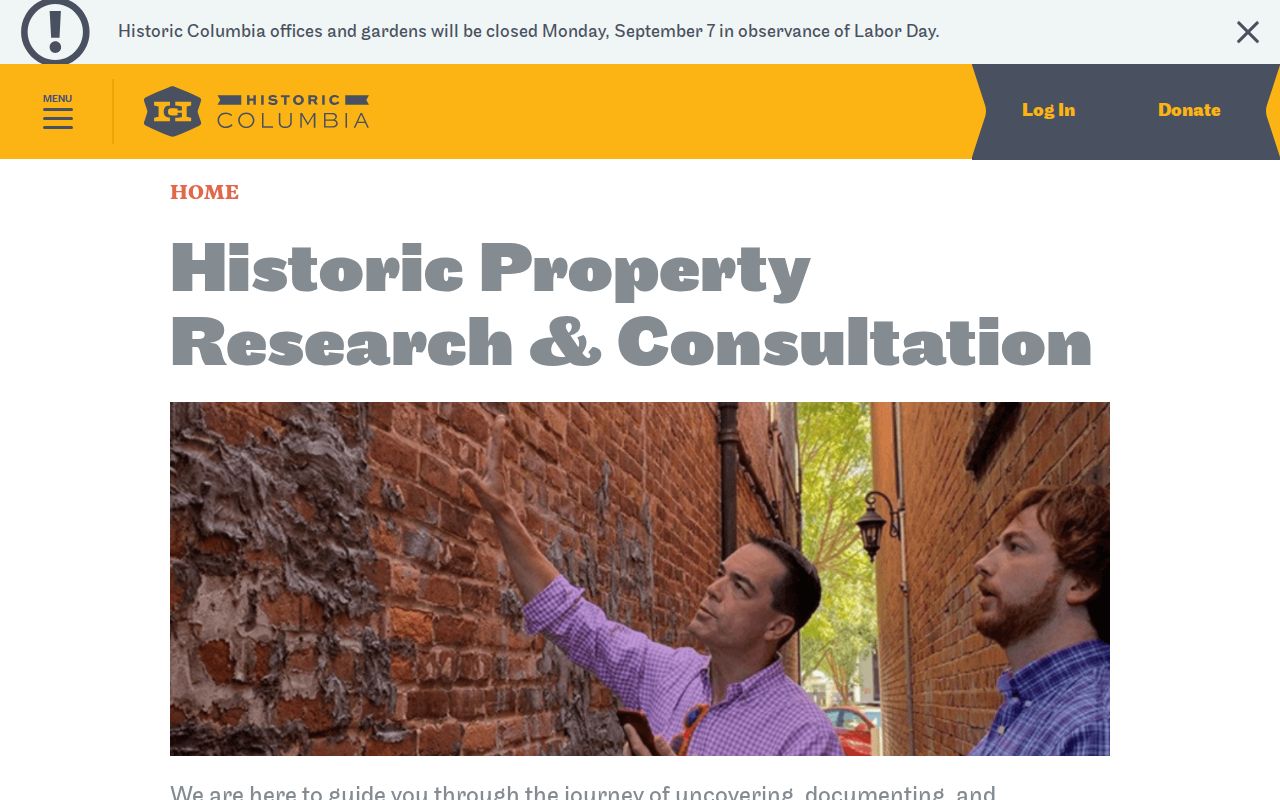
Pair that assistance with the official ROD and assessor records because consultation is not an official title search. The research found no verified citywide renumbering date, so compare cross streets, plats, old directory conventions, and map sheets instead of assuming a vanished number marks a vanished home.
Columbia Previous Residents and Estate Clues
Probate can explain why a deed party changed after a death. Richland Probate Court's Estate Inquiry covers estates filed after 1983 online; earlier estate material is available at Probate Court. An estate record may identify a decedent, personal representative, will, accounting, or deed of distribution. It should be read as an estate and transfer clue, not as proof that every named relative lived at the address.
The Walker Local History and Obituary Index and its request service can provide dated notice leads from Columbia publications. Test an obituary's relationship and timing against probate or an eligible vital-record route. Older records have access controls, and confidential certificate rules remain separate from a historical newspaper listing.
For a known estate that predates the online inquiry, Probate Court's estate copy order form covers records from 1900 forward. It asks for the decedent's name, death month or year, requested document type, and delivery information. The form lists a $3 pre-1983 search, 50 cents per copy, $5 certified copies, and $20 authenticated copies. It is a copy-request channel, not a substitute for a carefully matched estate trail.
Respectful Columbia Previous Resident Research
House and family history works best when the record is treated as limited evidence. Avoid posting sensitive identifiers, assume no living person's presence from a tax or directory entry, and check the custodian when a record appears incomplete. South Carolina's Address Confidentiality Program can provide a substitute mailing address for qualifying participants, and other privacy rules can limit public displays.
Lawful use. Columbia previous-resident research is for family history, estate questions, and property curiosity. Do not use records to track, harass, intimidate, or harm any person.