
Columbia Directory Holdings
Columbia's historical shelf is split among a university collection, Richland Library's local-history resources, and archival channels. The clearest online starting point is the USC South Carolina City Directories collection. Its Columbia run begins with 1859 and continues through selected volumes ending in 1927. It is a strong run, not an annual run. The library adds later telephone directories, printed local material, indexed notices, and staff help. Each source records a different kind of connection, so the volume date and collection type belong in every research note.
| Collection | Years | Where Held | Access |
|---|---|---|---|
| Columbia city directories | 1859, 1860, 1868, selected years 1875-1927 | USC South Carolina City Directories | Digitized collection |
| Southern Bell telephone directories | 1931, 1934, 1935, 1937, 1942, 1951; digital examples 1935, 1942, 1954 | Walker Local and Family History Center | Reference holdings and selected digital copies |
| Local History & Obituary Index | No single range stated | Richland Library | Searchable index and request channel |
| Richland tax duplicate books | Select exact years in the index | SC Department of Archives and History; Walker microfilm | Archive and library research |
USC identifies the 1911 volume as a 467-page work by Walsh Directory Co. The 1860 volume is attributed to Julian A. Selby and has 64 pages. Those catalog details show why a researcher should cite the edition actually used rather than treating a title as one uniform series.
Note: A name missing from an unissued or unavailable year cannot, by itself, establish that the household left Columbia.
Columbia Digitized Directory Years
The digitized Columbia volumes currently evidenced at USC are 1859, 1860, 1868, 1875-76, 1879-80, 1888, 1891, 1895, 1897-98, 1899, 1901, 1903, 1904-05, 1905, 1906, 1907-08, 1909 through 1917, 1922, and 1927. Search within a volume when the spelling is known, but also browse the surrounding page and the street department. Initials, abbreviations, and punctuation often matter in a historical city directory. The collection is useful for a dated listing, not a claim that every Columbia household was included.
- 1859: earliest Columbia volume currently evidenced in the USC collection.
- 1860: Julian A. Selby's 64-page cataloged volume.
- 1911: Walsh Directory Co.'s cataloged 467-page volume.
- 1927: latest Columbia volume in the documented, noncontinuous USC run.
The digitized 1911 Columbia directory is a practical example of a cataloged volume with searchable resident and address text.
Use the volume's own title, creator, date, and pages when saving a citation, because similarly named directories can represent different editions or publishers.
Columbia Directory Research at Walker
The Walker Local and Family History Center is on the first level of Richland Library's Main location at 1431 Assembly Street. Its listed hours are Monday through Friday, 9 a.m. to 6 p.m., Saturday, 2 p.m. to 6 p.m., and Sunday closed. Walk-ins are welcome, appointments are available for local-history or genealogy assistance, and the Center offers a remote obituary-request option. Check current hours before a visit.
Richland Library's Local History Digital Collections gateway is the library channel for its Columbia city-directory material. The broader digital focus also reaches Forest Acres, Arcadia Lakes, Blythewood, Eastover, Irmo, and unincorporated Richland County. That context matters when a household connected with Columbia appears under a nearby municipal label in a dated source.
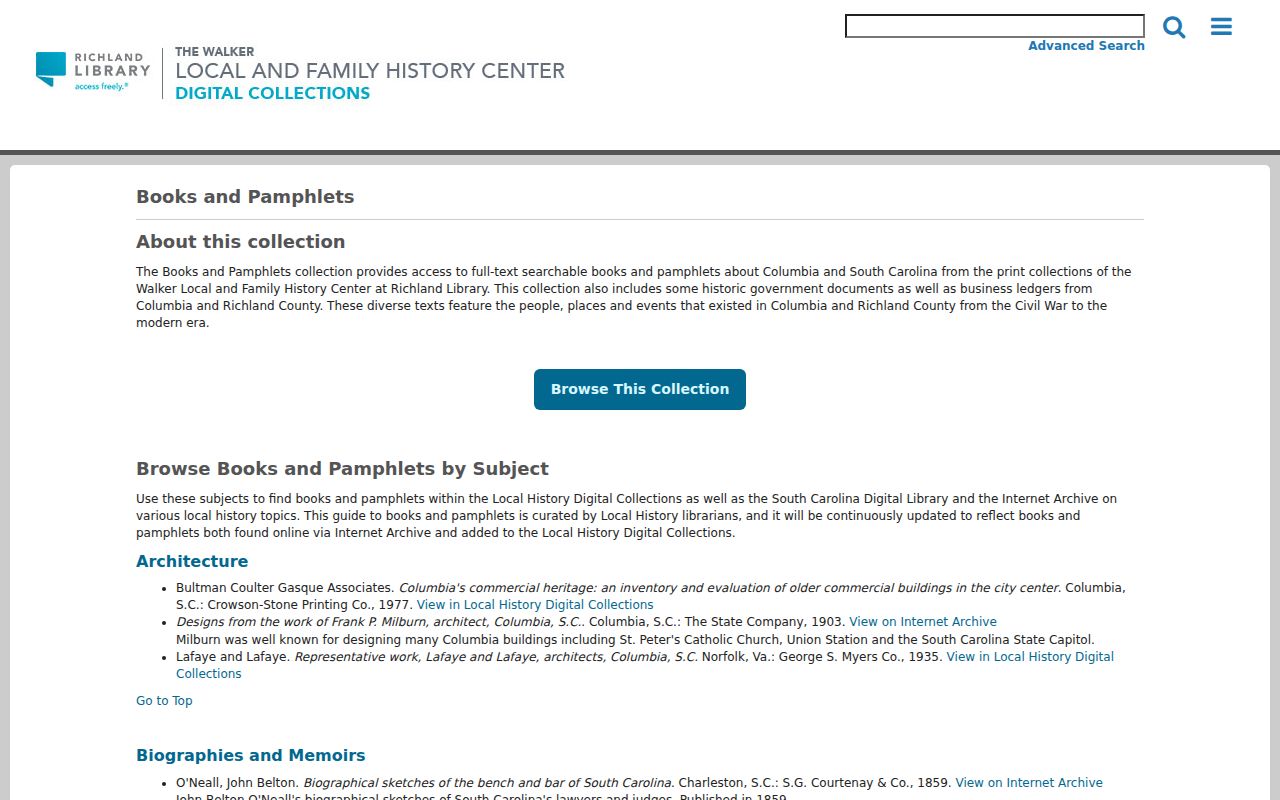
The collection gateway helps identify the relevant library material, while the volume or item date remains the evidence for a particular historical listing.
Walker highlights Columbia city directories, genealogy databases, FamilySearch Affiliate access, local newspapers and magazines, the Local History & Obituary Index, and digital collections. In-library sources include Ancestry Library Edition, while other channels include HeritageQuest, History Commons, NewsBank, and the library's own historical collections. That mix helps when a scan has a gap, a printed reference volume is needed, or a newspaper notice can test a directory trail.
The Main Library location page identifies the public library location used for this local-history research.
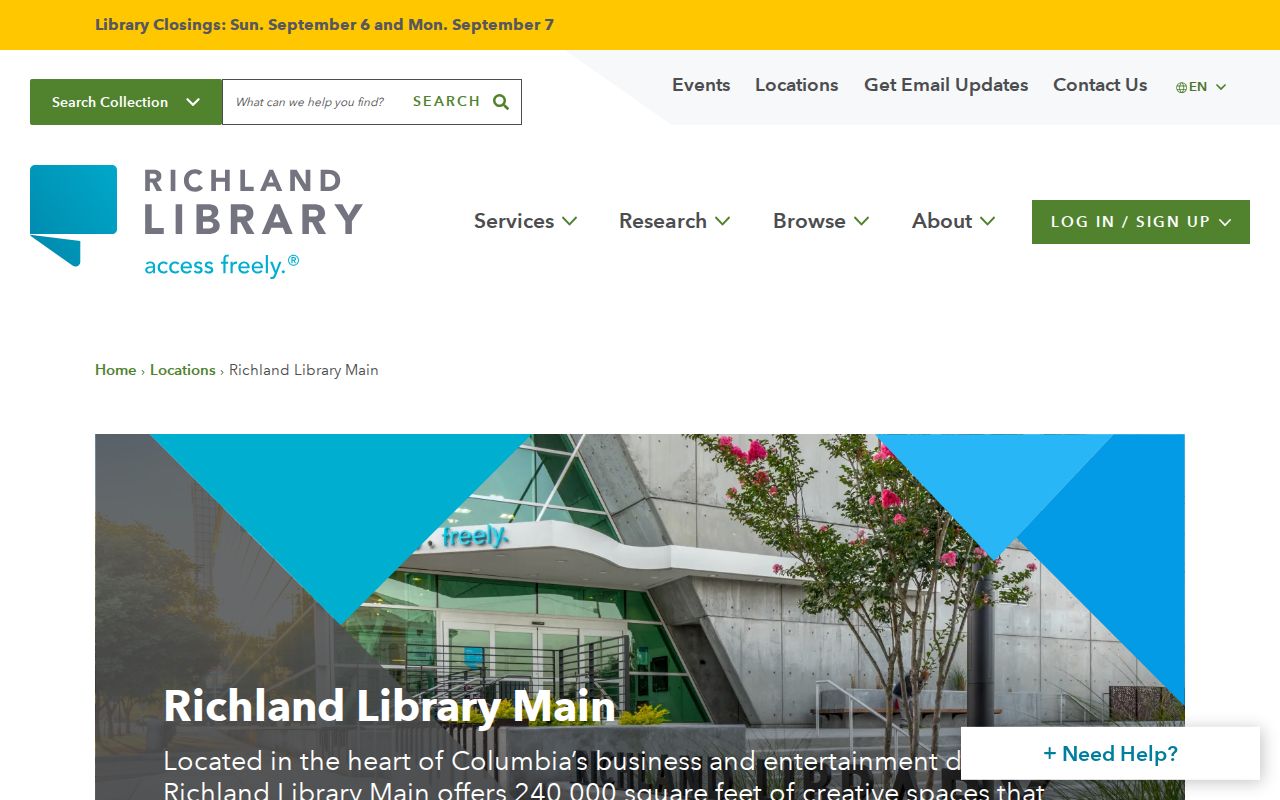
The library is a research channel rather than a substitute for a dated volume: preserve the issue year and compare each listing with independent records.
Reading a Columbia Directory Entry
A compact 1905 entry shows the value of reading every abbreviation. “Summer Geo E (Susie), carp, r 1613 Sumter” gives a surname, given-name initials, spouse notation where supplied, an occupation, and a residence marked with r. It does not identify every person in the house, prove ownership, or prove a present address. Copy the entry exactly, including the street form and punctuation, before making a modern comparison.
| Name | Surname and given name or initials as printed. |
|---|---|
| Spouse notation | A name in parentheses when the volume supplies one. |
| Occupation | A dated work description or abbreviation, such as carp for carpenter. |
| Residence | r marks residence in the 1905 example, followed by the listed address. |
| Street form | The historic spelling and number should be preserved for later map and parcel work. |
- Householder listing
- A listing centered on a named person or household contact, not a complete population count for an address.
- Abbreviation key
- The volume's front matter or entry patterns that explain short forms such as the residence mark in the 1905 example.
- Criss-cross directory
- A directory arranged by street or address rather than only by name. No complete Columbia reverse or criss-cross year run was verified in the available research.
Note: Inspect a title page and index before calling any Columbia volume a reverse or criss-cross directory.
Columbia Directory Telephone Bridges
Richland Library documents Southern Bell Telephone and Telegraph Company holdings for 1931, 1934, 1935, 1937, 1942, and 1951. Digitized examples include December 1935, April 1942, and November 1954. The 1942 book has 194 pages with alphabetical and classified sections, civic and county data, transportation information, a Greater Columbia map, and post-office information. The 1954 volume digitizes the alphabetical run in alphabetical page blocks.
Telephone books bridge some years after the USC city-directory run, but they are subscriber lists. A subscriber may be absent, a business may appear, and a listed telephone address is not a complete household record. Pair a telephone listing with a dated directory, obituary notice, probate record, map, or property record when the question concerns a particular family.
The 1865 Columbia Courthouse Fire
Richland County's early record trail has a major break. The SC Department of Archives and History reports that federal occupation and a February 1865 fire in Columbia destroyed the courthouse and most county records, while equity and probate records had been moved to safety. That history explains why a family search can move from a directory volume to an archive catalog without finding a parallel early deed or court file.
Surviving and reconstructed series include conveyance indexes from 1872-1908, conveyance books from 1865-1951, plat books from about 1871-1924, tax duplicates from 1876-1960, and voter-registration books from 1948-56. The SCDAH Richland County guide also warns that 1921 Columbia city-block plats are restricted because of their physical condition. A gap can be a custody problem, a fire loss, or an access limit, not proof that a person was absent.
Tracing Columbia Directory Households
Start with the best anchor available, such as a surname, a street address, or a narrow period. Choose the nearest available issue, then transcribe the name spelling, initials, address, telephone number where present, and nearby names exactly. Move backward and forward through the available volumes. A changed number, altered spelling, or missing listing is a prompt for more research, not a conclusion.
- Locate the household in the closest dated Columbia directory or telephone book.
- Record the entry as printed, including initials, spouse notation, occupation, and historic street style.
- Check the preceding and following available volumes for the same name and address variations.
- Pair the directory era with the nearest released federal census, then test a property identity through tax, assessor, or recorded-land material.
- Use the Walker obituary request channel and probate material to investigate a death or estate transition.
For a current property question, the modern address-keyed chain belongs with the Columbia Street Directory. A historical listing can supply a useful name and date, but property ownership and residence remain different claims.
Note: A directory disappearance may reflect a move, death, unlisted service, changed format, or a gap in the surviving run.
Columbia Directory Street Context
Columbia's original layout offers a useful check on a historical address. The capital was laid out in 1786 as a 400-block grid, and the 1905 Street and Avenue Department described an even-and-odd side convention for that historical directory. Treat it as a dated convention, not a promise about every present street number. Cross streets, ward or neighborhood wording, plats, and maps give a safer continuity test.
Older street names matter too. Local historical references identify Walnut for Blanding, Lumber for Calhoun, Upper for Elmwood, Medium for College, and Green for Greene. “Devine” can also appear as “Divine.” Search both historic and current terms, then test the block against a Sanborn sheet and the parcel's legal description. The 1919 Columbia Sanborn map has 77 sheets and can establish building or street context, not personal occupancy.
Columbia Directory Archive Gaps
Digitization in Columbia is collection by collection. Richland Library volunteers transcribed City Council minute text, USC digitized directories and maps, and the ROD's modern subscription system begins far later than the historical shelf. There is no single conversion year for Columbia records. Date the source, name the custodian, and use a counter, library, archive, or request path when the screen does not reach the needed era.
Yearbooks, oral histories, photographs, newspapers, and tax-book indexes can strengthen a directory trail. Richland Library's school-yearbook collection includes examples from Columbia schools, while its oral-history material documents local memory from 1985 forward. Walker accepts obituary requests with a full deceased name, death date or year range, and residence, up to three requests weekly, with a general 48-hour response. These sources locate a person or place in a period; they do not replace a directory entry or establish current residence. A name requiring modern confirmation can be tested through the Columbia Resident Lookup record paths.