
Finding Columbia Residents Through Records
Start with the record tied closest to the question. An address usually belongs first in the Richland property search, where it can be connected to a tax map and a physical parcel. A name tied to a transfer belongs in the Register of Deeds index. A dated household question belongs in a city directory, telephone book, census, obituary index, or estate file. Each is a partial record. A parcel owner, recorded grantee, telephone subscriber, and court party are not interchangeable labels for the same person.
Columbia also crosses into Lexington County. Confirm the parcel county before relying on a Richland office, even when a mailing address says Columbia. A City limits layer can help with orientation, but the tax map and serving county establish the practical records path.
- Use the known address, owner spelling, or tax-map number in the Richland property tools and record the situs, mailing, and tax-map fields separately.
- Follow a property clue into the Register of Deeds with the tax map, legal description, party name, book and page, or address.
- For a person’s own election record, use the identity-verified MySCVotes route. For lawful inspection questions, contact the county election office.
- Match a historical name to a dated city or telephone directory, then test it with a census, probate, obituary, or land record.
- When a named record is not online, request that existing record from the right custodian or use its counter and archive channels.
Note: A no-match may reflect the wrong county, an older record, a name variant, a protected record, or a limited search field.
Columbia Resident Records Desks
Richland County’s courthouse cluster supplies the core land, court, and estate routes for a Columbia address in that county. The Assessor maintains appraisal and tax-roll context. The Register of Deeds preserves recorded instruments. The Board of Voter Registration and Elections handles the election-record route. The offices answer different questions, so a careful Columbia residents directory search keeps their results in their proper lane.
Richland County Register of Deeds
1701 Main St., Room 101
Columbia, SC 29201
803-576-1910
Richland Voter Registration & Elections
300 Columbia Mall Boulevard, Suite 210
Columbia, SC 29223
803-576-2240
Columbia Parcel Clues for Residents
The Richland Property Card is a strong starting point for an address, not a household roster. Basic Search accepts Tax Map #, Address, or Owner. Advanced Search adds tax district, neighborhood, acreage, construction details, transaction date, and transaction price. A returned card may display owner, mailing address, situs address, taxable value, tax map, characteristics, and a map link. Capture the displayed labels and its as-of date.
| Property Card key | Use in a Columbia search | Limit |
|---|---|---|
| Address | Find a likely parcel and physical situs | Street labels can change over time |
| Tax Map # | Anchor the parcel across county systems | Not every deed includes it |
| Owner | Find owner-of-record entries | Owner does not prove occupancy |
| Mailing address | Identify the tax correspondence field | It can differ lawfully from the situs |
The Richland Property Card search supplies the county’s address, owner, and tax-map entry points. Use the resulting tax map and legal description to test a deed trail. Do not restate a mailing field as a home address without separate evidence.
Columbia Deed Trails and Dates
Richland’s Register of Deeds makes recorded land evidence available through a subscription service and at its counter. The online index reaches from January 10, 1984 forward, while online document images begin February 19, 1998. Older work and image gaps require the counter or copy process. The office’s search choices include tax map, instrument book and page, name or firm, address, and legal description. The county recommends tax-map searching, but warns that a deed may lack both a street address and tax-map number.
Find the current acquisition instrument, note the grantor, grantee, date, book or instrument number, derivation clause, and legal description. Then search the seller as a prior grantee and test the legal description again. A street-address miss is not proof that there is no deed. The Columbia street directory explains the address-first side of that process.
- Parcel
- A defined piece of land in the tax and map system.
- Situs address
- The physical street location used to orient a parcel.
- Legal description
- The lot, plat, subdivision, or metes-and-bounds land identity used in recorded instruments.
- Derivation clause
- A deed reference that points to the earlier instrument from which title was derived.
Property data provides the parcel anchor that makes a recorded party search more reliable. The deed itself records a transaction, not everyone who was present at the property.
Current Columbia Resident Directory Sources
There is no one official roll of all Columbia residents. Current sources are created for tax administration, election administration, court cases, estates, or a public filing. They may connect a person to a place or event, but each has a stated purpose and access rule. Use two independent sources before treating a name match as meaningful.
| Columbia source | What it can establish | Custodian | Access route |
|---|---|---|---|
| Property Card | Owner of record, tax map, situs and tax mailing fields | Richland County Assessor | Address, owner, or tax-map search |
| Recorded land index | Recorded party and instrument trail | Richland Register of Deeds | SMS subscription or counter |
| Voter registration record | Lawful registration confirmation or inspection path | State and county election offices | Verified self-check or controlled route |
| Public Index | Party role, case locator, and docket context | South Carolina Judicial Branch | Richland-filtered court search |
| Estate Inquiry | Decedent and estate existence | Richland Probate Court | Online after 1983 or court counter |
A person-focused question needs a record-by-record comparison, including name variants and dates. The Columbia resident lookup route has that narrower verification workflow.
Columbia Voter Records Have Limits
MySCVotes is not an open name browser. Its self-check calls for county, first name, last name, date of birth, last four Social Security digits, and CAPTCHA verification. A verified voter can use the tool for their own registration details and related election functions. South Carolina law also makes registration records open for public inspection, with restrictions for identifiers and protected addresses.
The state’s voter-list product has eligibility and use controls. It is not a street-by-street list of every household. An absent result can have several explanations, including a county mismatch, status change, protected record, or no registration. Election data can corroborate a lawful, specific record, but it should never be treated as a complete Columbia residents directory.
The South Carolina Department of Corrections search is shown below. It offers Basic and Phonetic Match options for custody records, which are not evidence of a current Columbia address.
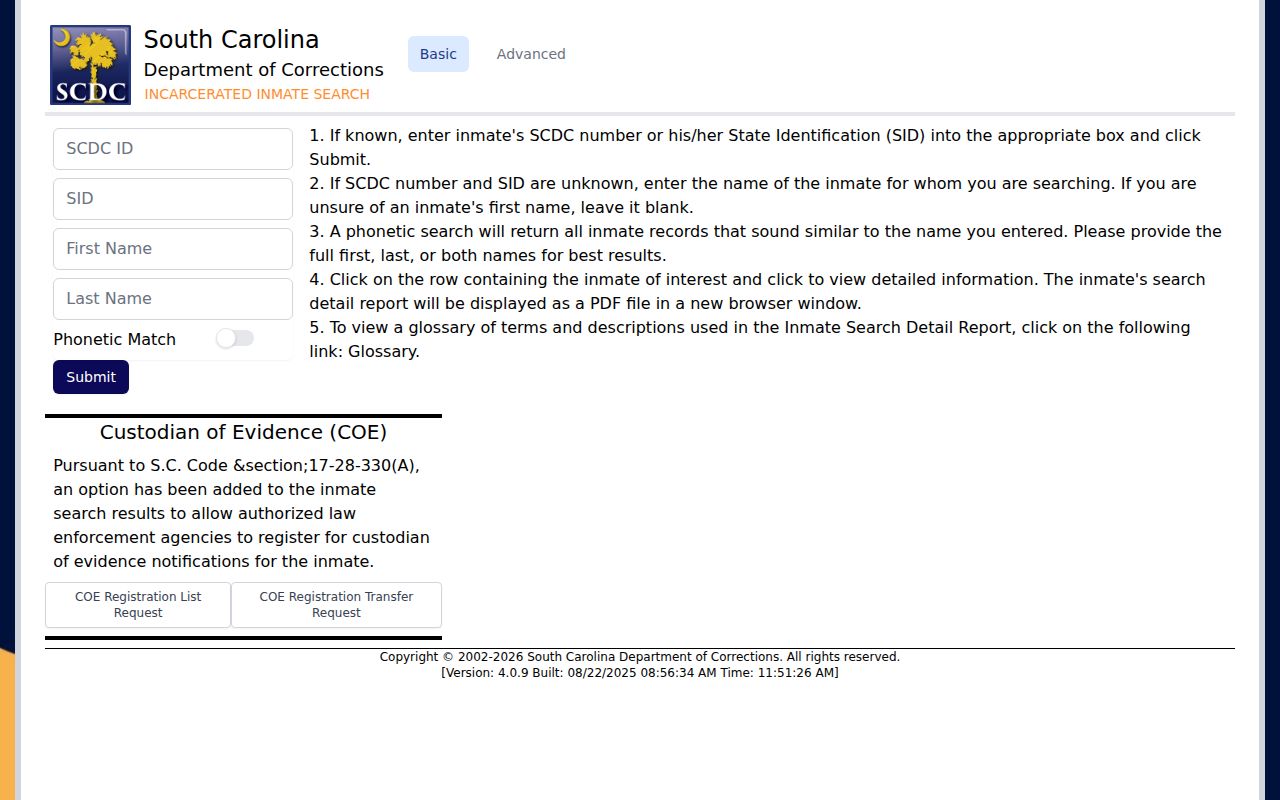
Agency status records need their own dates and cautions. They should not be used to construct a profile of a resident.
Columbia Court and Estate Names
For a court name search, select the correct county and court agency before drawing conclusions. Columbia Municipal Court directs users to the Richland Public Index and identifies Columbia Municipal Court as the Court Agency filter; its online record range is 1988 forward. A case index can show a party name, role, case number, filing date, court, status, and docket events. It does not establish a current address, and confidential, sealed, juvenile, adoption, and family material may be unavailable.
Probate is a separate route. Richland Estate Inquiry accepts a decedent’s first and last name and offers online estates after 1983. Earlier estates are available through Probate Court. A probate file can identify an estate and representative or explain a recorded transfer, but it does not prove all relatives or present residence.
The Richland Estate Inquiry is shown below with the decedent-name search fields used for a Columbia estate trail.
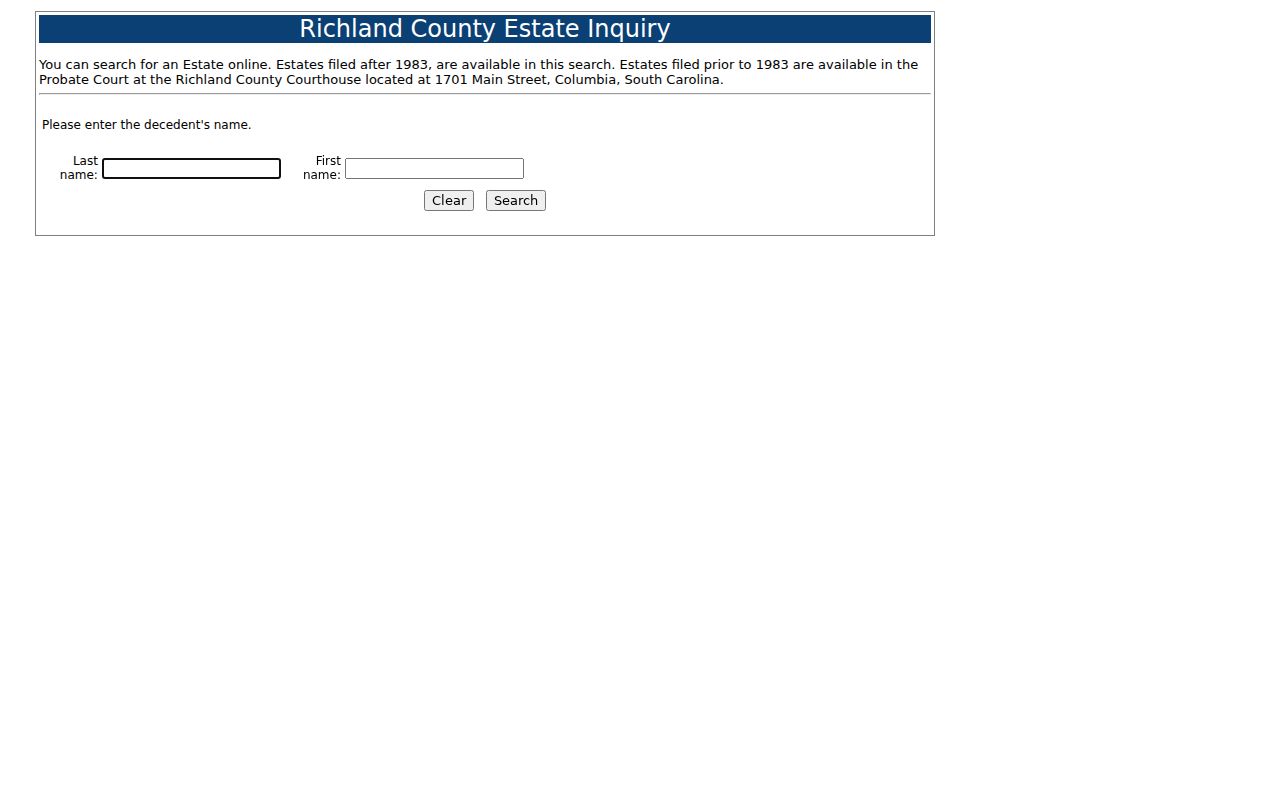
The date cutoff affects the access route, not the existence of an older estate. Contact the Probate Court or use its counter for pre-1983 research.
Note: Confirm a same-name result with a second official record and retain uncertainty where dates, county, or parcel details conflict.
Columbia Vital Record Boundaries
South Carolina Department of Public Health, not the City or Register of Deeds, keeps statewide vital records. Birth records become public after 100 years under S.C. Code §44-63-80. Death records become public after 50 years under §44-63-84. Before those public eras, certified copies have eligibility rules. DPH’s marriage certificates cover July 1950 through December 2023; a Richland marriage outside that range begins with Probate Court. Divorce reports begin July 1, 1962, while the decree belongs with the Clerk of Court.
A certificate request is an event-record process, not a general name lookup. DPH provides mail, online or phone, and state-office channels as currently available, with identification and fee rules that vary by method. Its standard mail search is $12, expedited search is $17, and additional same-type copies ordered together are $3.
The DPH marriage-certificate instructions in this Columbia residents directory image show the official request route.
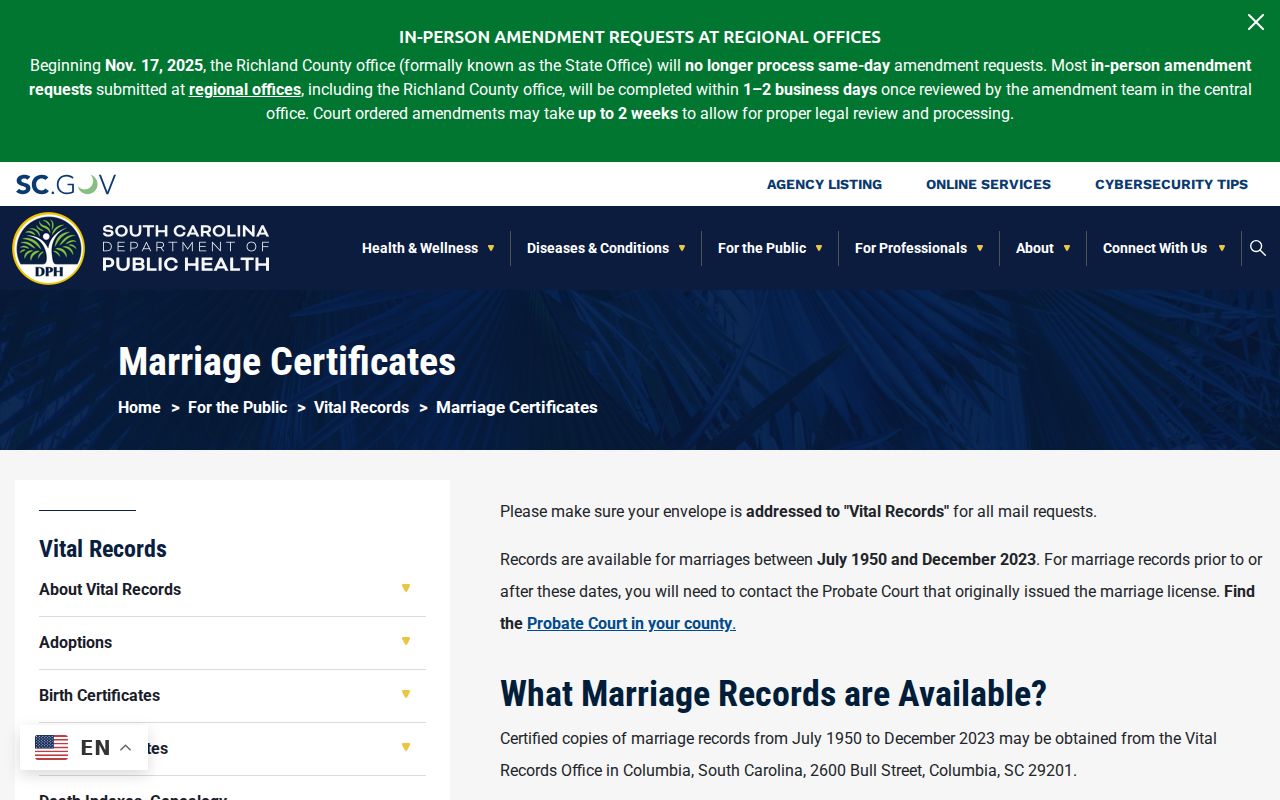
Use the event county and period to choose the custodian. A certificate, a court decree, and an obituary have different legal roles.
Historical Columbia Resident Directories
USC’s digitized South Carolina City Directories collection documents Columbia volumes from 1859 through 1927, with gaps rather than an unbroken annual run. The 1911 volume is attributed to Walsh Directory Co. and has 467 pages. Richland Library’s Walker Local and Family History Center adds later Southern Bell telephone directories in reference years including 1931, 1934, 1935, 1937, 1942, and 1951, plus digital examples from 1935, 1942, and 1954.
A directory entry is a dated listing, not proof of a full household or current residence. Its spelling, initials, occupation notation, telephone context, and street format should be copied as printed. The Columbia city directory page examines those collections and entry conventions in depth.
Columbia Records Requests Under FOIA
The South Carolina Freedom of Information Act is the written fallback for an existing non-exempt City or County record that lacks an online search. A focused request identifies the document type, date range, custodian, parcel or case number, and desired copy format. It does not require an office to create a new list of people. The law ordinarily requires a written determination within 10 business days, or 20 days for records older than 24 months. A granted request is ordinarily produced within 30 calendar days, or 35 for older records, subject to lawful redactions and a permitted deposit.
Richland County publishes its fee schedule and request route. The County public-records page is shown below and is the right starting place for a clearly identified county document.
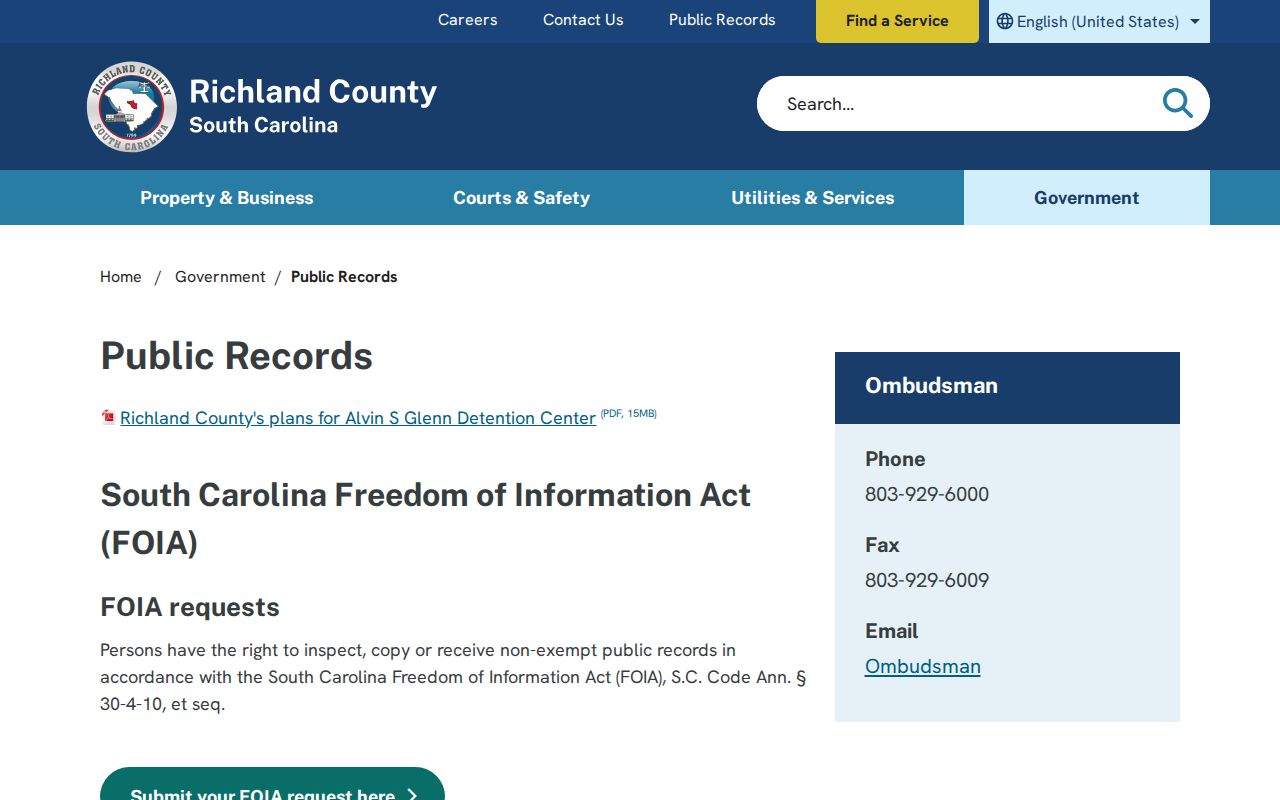
FOIA does not override vital-record eligibility, court sealing, juvenile protections, library privacy, protected-address programs, or federal limits on motor-vehicle data.
Columbia’s 1865 Records Break
Richland County was created in 1785, but federal occupation and fire in Columbia in February 1865 destroyed the courthouse and most county records. Equity and probate records had been removed to safety. That history explains why an early name or land trail can stop even when a later online portal seems complete. It is a records gap, not proof that a family or parcel had no earlier history.
SCDAH identifies surviving or reconstructed material such as conveyance indexes from 1872 to 1908, conveyance books from 1865 to 1951, tax duplicates from 1876 to 1960, probate real-estate books, and voter-registration books from 1948 to 1956. The department’s map collection became searchable through its catalog in May 2025, providing another way to locate plats and historic map material.
The South Carolina Department of Archives and History catalog appears below. It supplies an archival path for materials that predate county web systems.
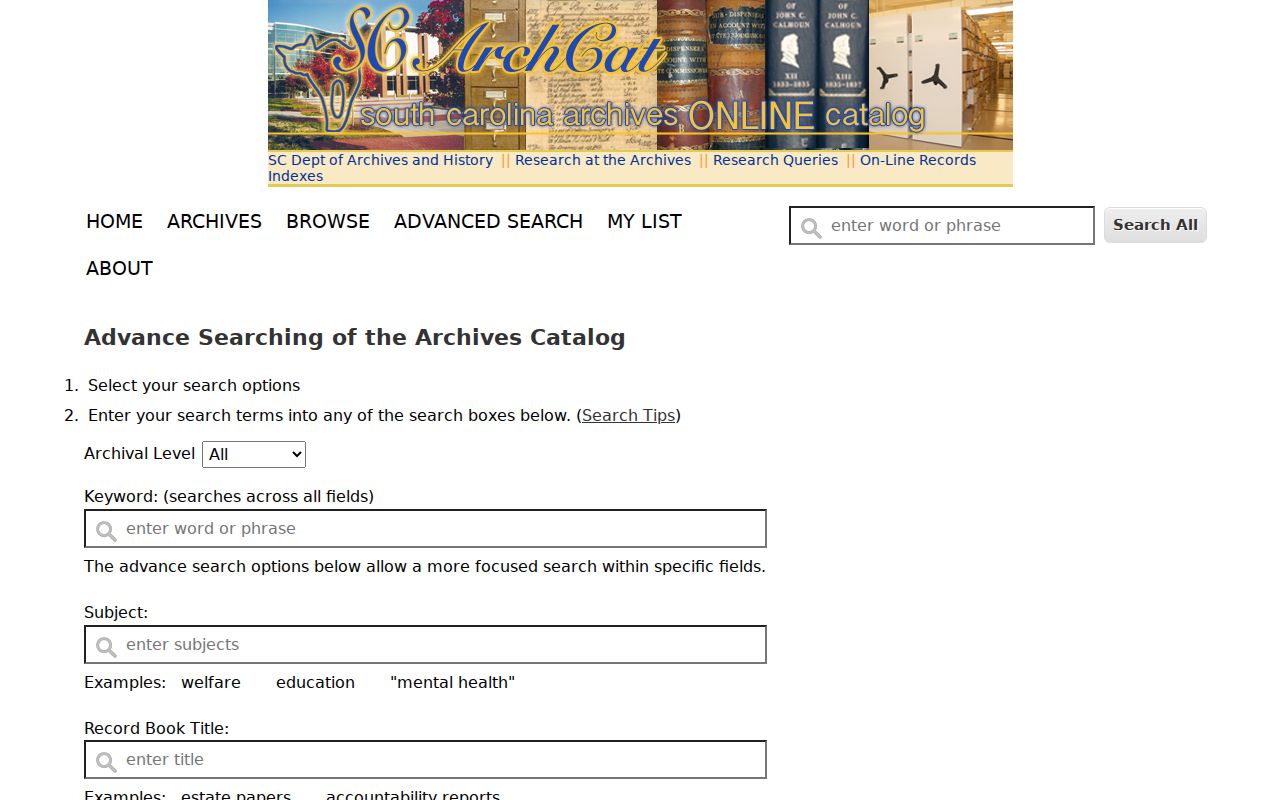
Search the catalog by Columbia, Richland County, personal name, date, and record group. Then verify the item’s exact coverage before a visit.
Columbia State Search Channels
State systems can answer a narrow question that county records cannot. The Secretary of State’s Business Entities Online search can corroborate an entity or registered-agent filing, but it is not residential proof. Board-specific LLR lookups can confirm a credential where a board publishes one. The Treasurer’s unclaimed-property search may provide a name-and-holder lead that still needs verification.
The Secretary of State business search screen below is an official association tool. Its own status information should be read narrowly: good standing means an entity has not been dissolved in that office’s records.
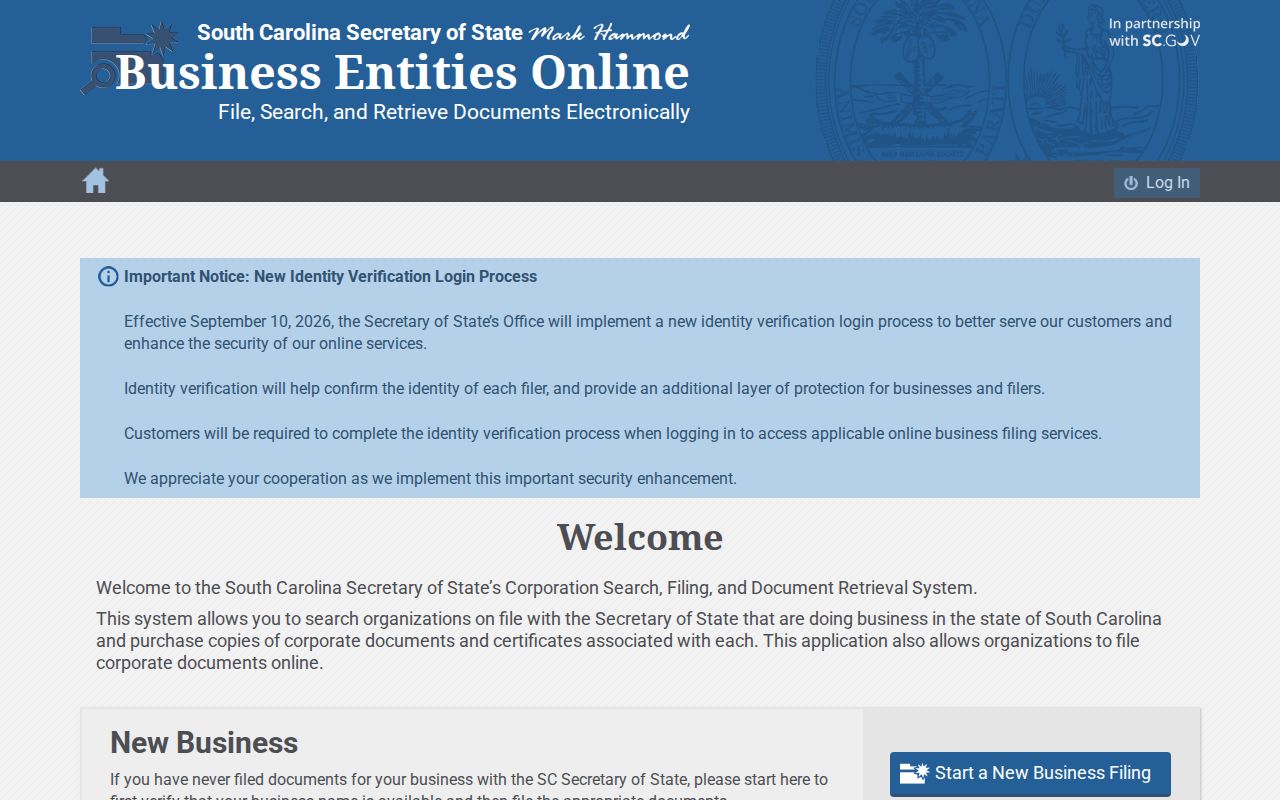
Keep business, license, custody, and property evidence separate. They may corroborate a time-specific connection, but none alone states where a person lives.
Using Columbia Resident Records Safely
Official sources and commercial compilation tools differ in purpose and quality. A custodian can explain its record, correction channel, coverage, and legal limits. A compilation may combine stale or mismatched records and may not show its source date. When a public field is wrong, contact the office that controls it, such as the Assessor for a property-mailing correction, the election office for a voter issue, the Clerk for court indexing, or DPH for a vital-record amendment.
| Source type | Best use | Important caution |
|---|---|---|
| Official custodian record | Verify a specific record purpose and date | May be incomplete, redacted, or restricted |
| Archive or library collection | Build a historical, dated trail | Listing and map sources are snapshots |
| Commercial compilation | Recognize it as a possible lead only | May conflate people or carry outdated data |
Lawful use. Columbia records support family history, estate questions, civic research, and personal verification. Do not use them to stalk, harass, intimidate, or harm anyone.
The South Carolina registry information page is pictured below because it carries a particularly clear accuracy and misuse warning.
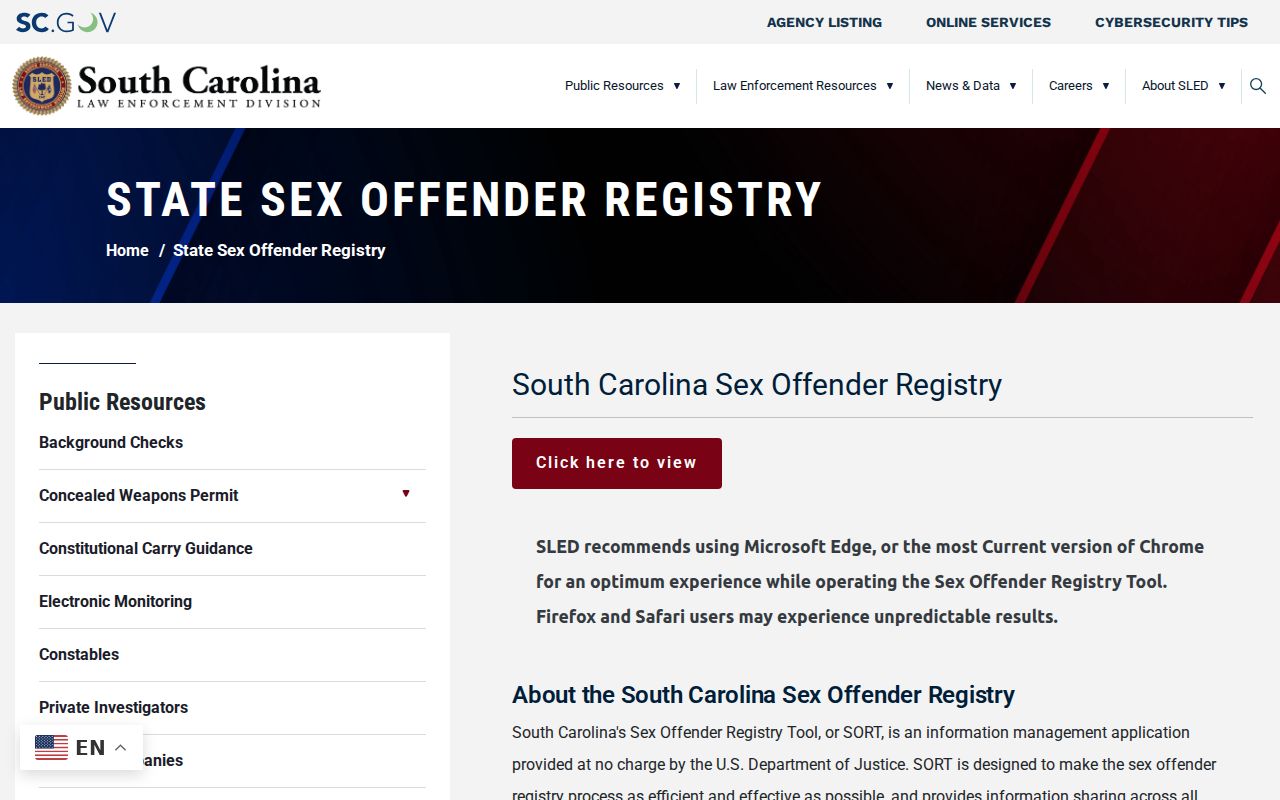
Preserve the source and date of any official result, and use the agency correction channel when a record appears inaccurate.